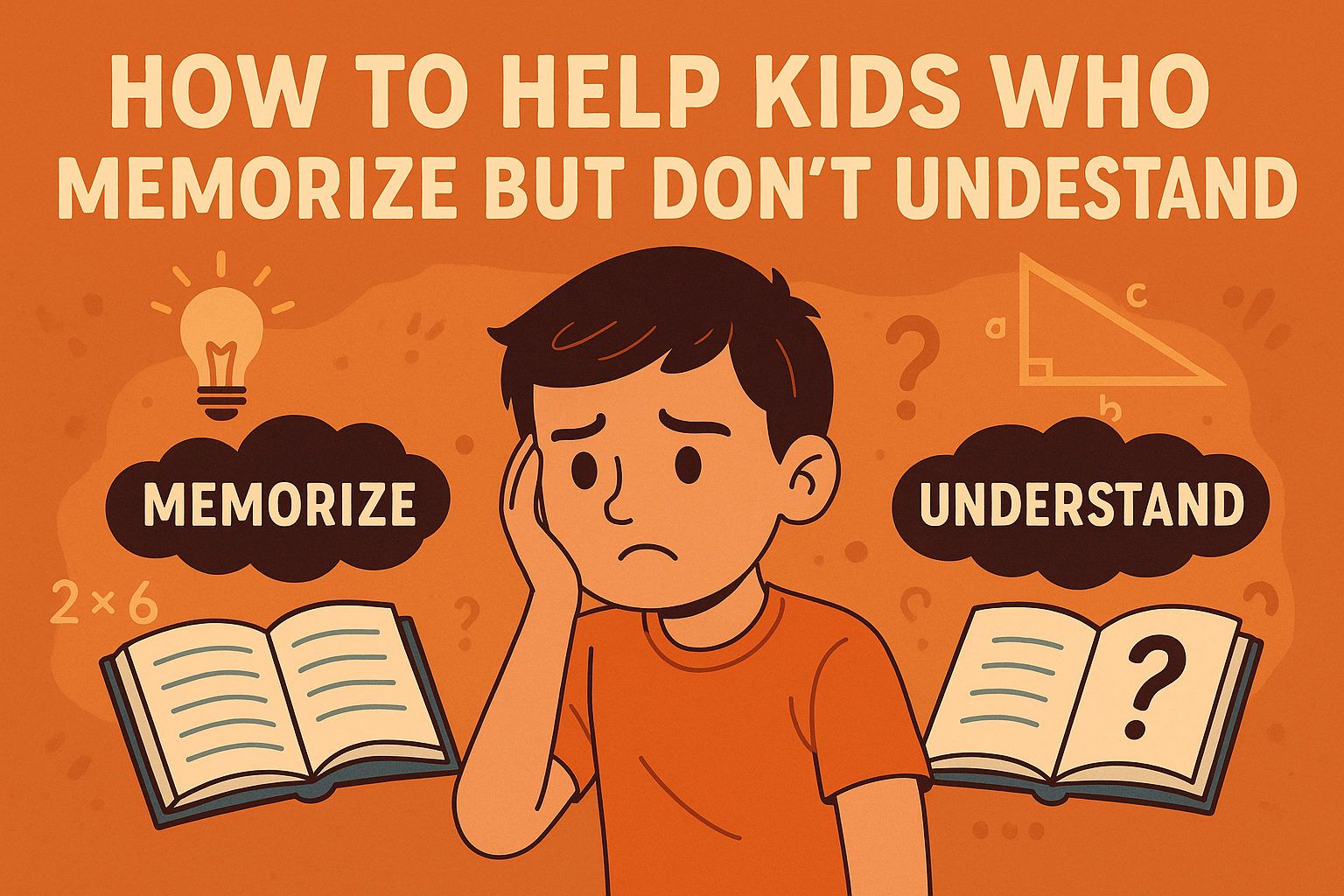
Many children memorize answers beautifully—but struggle the moment the question is framed differently.
If you’ve seen your child score well in class tests but freeze during application-based questions, you’re not alone. This “rote learning trap” is incredibly common, especially in early and middle school years.
The good news? With the right strategies, kids can shift from remembering to genuinely understanding.
Here’s a simple, practical guide to help your child build real conceptual clarity.
1. Identify the Root of the Problem
Before jumping into solutions, check for signs that your child is depending only on memory:
- They can repeat definitions but can’t explain them in their own words.
- They forget concepts quickly unless they revise frequently.
- They struggle with twisted or application-based questions.
- They avoid problem-solving but love “notes” or “important questions.”
Understanding this helps you support them more effectively.
2. Encourage “Teach-Back Learning”
One of the easiest and most powerful strategies:
👉 Ask your child to teach the concept back to you.
If they can explain it simply, they’ve understood it.
If they fumble, it’s a sign they memorized without clarity.
This method rewires learning from passive to active.
3. Replace Notes With Real-Life Examples
Kids understand better when concepts feel real.
Example:
Instead of memorizing “multiplication is repeated addition,” let them count chocolates, building blocks, or cricket scoreboards.
Linking learning to daily life helps the brain store concepts more deeply.
4. Use Why–How–What Questions
Rote learning answers what.
Understanding answers why and how.
Try these:
- Why does this formula work?
- How is this topic used in real life?
- What happens if we change something in the question?
These trigger deeper thinking and reduce reliance on memorization.
5. Focus on Step-by-Step Problem Solving
Many kids memorize final answers but don’t know how they arrived there.
Break it down:
- What is the question asking?
- What information is given?
- Which concept applies here?
- How do we solve it step by step?
This builds conceptual confidence and reduces fear of new question patterns.
6. Swap Revision for Practice
Revising notes over and over = memorizing.
Solving new or twisted questions = understanding.
Encourage practice through:
- Worksheets
- Challenge questions
- Past papers
- Daily application-style problems
This exposes kids to different patterns and strengthens real understanding.
7. Use Technology to Support True Understanding
Adaptive learning tools can identify knowledge gaps that parents often miss.
Platforms like DeepSchool help kids:
- Learn concepts in small, personalized steps
- Get questions based on their real strengths and weaknesses
- Build mastery instead of memorization
- Learn through examples, hints, and instant feedback
If you want your child to move beyond rote learning, adaptive practice can be a game changer.
8. Celebrate Effort Over Accuracy
Many kids memorize because they’re afraid of making mistakes.
Shift the culture at home:
- Praise attempts, not just results
- Celebrate progress
- Show them that wrong answers help learning
A relaxed child learns better than a pressured one.
9. Keep Short, Frequent Study Sessions
Long study hours = fatigue.
Fatigue = memorizing without thinking.
Try:
- 20–30 minute focused study blocks
- Small breaks
- Alternating easy vs. tough subjects
This keeps the brain fresh and improves retention.
Final Thoughts
Kids don’t memorize because they’re “lazy.” They memorize because:
- It feels safe
- Exams reward recall
- They’re afraid of being wrong
- They haven’t been taught how to understand
With the right guidance, any child can shift from rote learning to real learning—and once that shift happens, confidence and grades shoot up naturally.
If you're looking for structured, personalized support, you can check out DeepSchool—a platform designed to help kids truly understand concepts and build long-term mastery.