By Apoorva Singh, Educationist and Researcher – Indian Education Pattern
The Central Board of Secondary Education (CBSE) has quietly done something historic.
From the 2026 board exams onward, both Class 10 and Class 12 students will face a very different kind of question paper—one that is deliberately designed to cut down rote learning and reward genuine understanding and application of concepts. The Economic Times
At the same time, Class 10 students will get two board examinations in a year, a structural shift meant to give them more flexibility in how and when they demonstrate their learning. The Economic Times+1
For parents and students, this is not “just another circular”.
This changes how India’s school-going generation will study, revise, and sit for one of the most anxiety-filled milestones of their lives.
In this piece, I am not going to simply restate the news. I’ll first lay out the exact changes, and then unpack what they really mean for study patterns, classroom practices, and exam preparation.
1. What Exactly Has CBSE Changed for 2026?
The key announcement has two parts:
a) a new question paper structure for Classes 10 and 12, and
b) a new exam policy for Class 10.
1.1 New Question Paper Structure (Class 10 and 12)
Starting with the 2026 board exams, CBSE has restructured the paper pattern as follows: The Economic Times+1
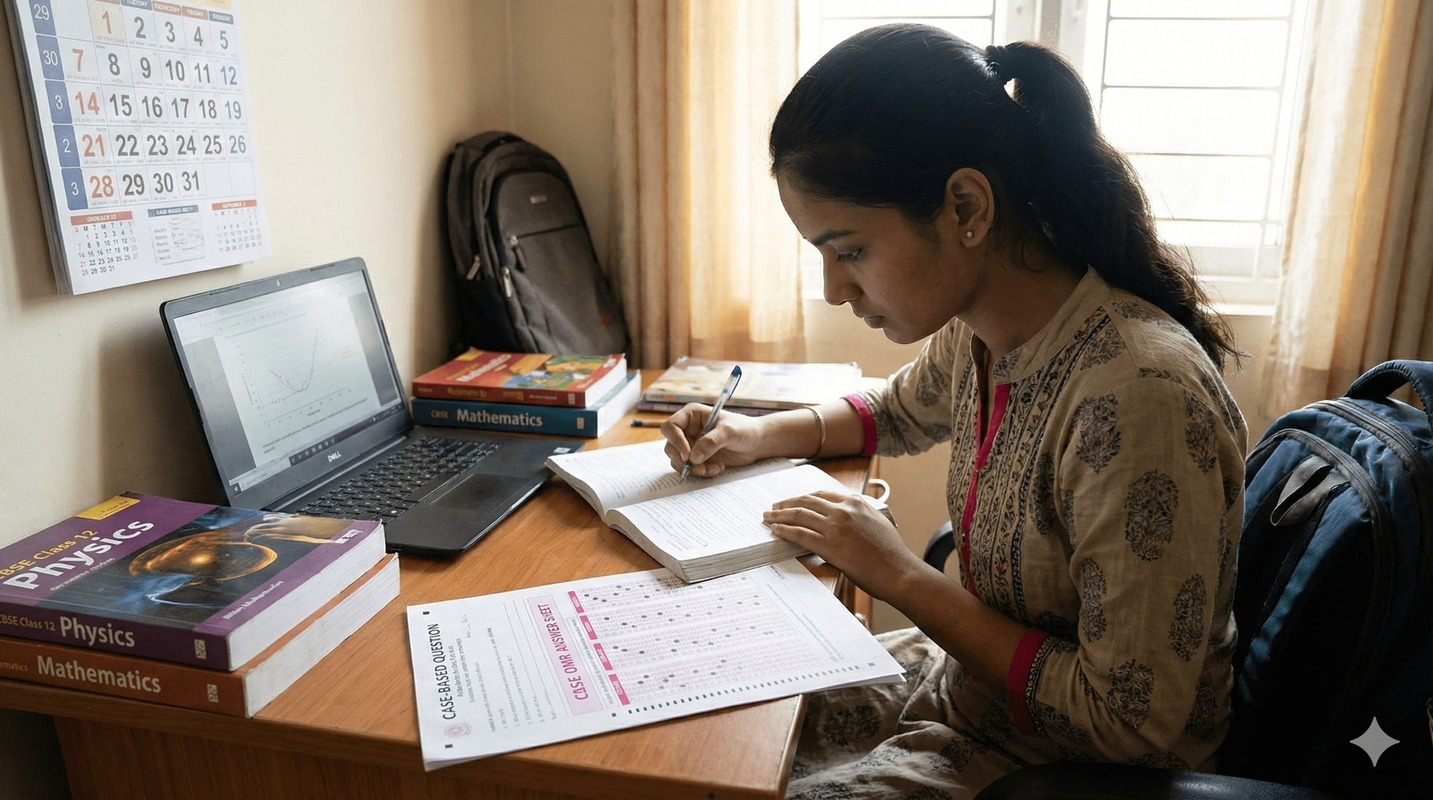
- Roughly half the paper (50%) will consist of competency-based questions. These will test how well students can apply what they have learnt. This category includes:
- multiple-choice questions,
- case-based items,
- source-based integrated questions,
- data interpretation tasks,
- and situational or real-life problem questions.
- Around 20% of the questions will be select-response items, essentially standard MCQs where students choose the correct option.
- The remaining 30% will be constructed-response questions—the familiar short-answer and long-answer questions where students write out their responses in their own words.
Two points are important here:
- The entire paper, not just a small section, is being reshaped.
- Application and reasoning now dominate; pure recall is no longer the main route to marks.
CBSE has explicitly framed this as a move away from “reliance on rote memorisation” towards deeper conceptual learning and better analytical and problem-solving skills. The Economic Times
1.2 Two Board Examinations for Class 10 from 2026
In line with the National Education Policy (NEP) 2020 recommendations, CBSE will shift to a two-exam system for Class 10 board exams starting 2026. The Economic Times+1
- Students will get two opportunities in a year to sit for the Class 10 board examination.
- The intent is to give students more flexibility and more than one chance to demonstrate what they know, instead of placing everything on a single, high-stakes exam.
Separate CBSE and media documents further explain that this biannual exam model is meant to reduce pressure, allow students to improve performance, and align with a more student-centric system. The Times of India
1.3 Exam Window and Schedule
For 2026, CBSE has also indicated a clear board exam window: The Economic Times+1
- Board exams for both Class 10 and Class 12 will begin on 1 February.
- Class 10 exams are scheduled to end on 10 March.
- Class 12 exams are expected to conclude on 9 April.
- On the opening day, Class 10 will sit for Mathematics (Standard and Basic), while Class 12 will have papers such as Biotechnology, Entrepreneurship and Shorthand.
So, this is not a theoretical change on paper; it is a dated, scheduled, implementable shift.
2. Why Has CBSE Done This?
CBSE is not operating in a vacuum. The NEP 2020 has been repeatedly clear on two expectations:
- Reduce rote learning.
- Move towards competency-based assessment that checks whether students can interpret, analyse, and apply knowledge.
The 50–20–30 distribution in the new paper pattern is a very direct operationalisation of this philosophy: half the paper is now explicitly dedicated to competency and application. The Economic Times+1
From a system perspective, this achieves a few things:
- Forces teaching to move beyond dictation of notes.
- Signals to coaching centres that pattern-based guessing has limited utility.
- Pushes students towards understanding “why” and “how”, not just “what”.
The two-exam system for Class 10, again, is NEP-aligned. It is an attempt to de-risk a single-exam culture, while nudging schools and students towards continuous, less panic-driven preparation. The Times of India+1
3. What Does This Mean for Students’ Study Habits?
Let us be very concrete.
With this pattern, a student who has:
- mugged definitions,
- memorised long answers,
- practiced only “important questions” from a guidebook,
will find that these strategies cover a much smaller fraction of the paper.
The exam is now built to reward students who can:
- interpret a graph or data table and draw conclusions,
- reason through a real-life scenario using a concept from Science, Math or Social Science,
- connect a text or source passage to broader ideas,
- choose between subtle answer options that test understanding, not just memory.
In other words, exam preparation must shift from “finishing the syllabus” to “mastering the concepts”.
The two-exam system also means that:
- Students have a second chance, which can reduce “all-or-nothing” anxiety.
- But it also demands earlier and more consistent preparation, because the first attempt will typically happen on a fixed February–March timeline. The Economic Times+1
4. Implications for Parents and Schools
For parents, especially in India’s high-pressure board culture, this reform changes the role you need to play.
4.1 What Parents Need to Watch For
- Over-focus on content, under-focus on thinking
If a child’s study time is still dominated by copying notes and memorising line-by-line answers, they are preparing for the old CBSE, not the 2026 one. Lack of exposure to new question types
Students must regularly see:- case-based questions,
- data interpretation tasks,
- situational problems,
- and multi-step MCQs.
If they encounter these formats only in the final sample paper, it is too late.
- Misuse of the two-exam flexibility
Some students may mentally postpone effort, assuming the second exam will rescue them. This is psychologically understandable, but academically risky.
4.2 What Schools Need to Rethink
Schools will have to align:
- Internal tests with the new 50–20–30 pattern, instead of continuing with fully descriptive papers.
- Assignments that ask students to interpret, argue, or apply, not just copy.
- Teacher training to write and discuss competency-based questions in regular classroom practice.
Without this alignment, students will experience a disconnect: traditional pattern in school, new pattern in the board exam.
5. Where DeepSchool Fits In (And Why It’s Relevant Here)
Now, how does a platform like DeepSchool enter this picture?
The key is this: CBSE has changed what it is measuring. It now emphasises:
- conceptual clarity,
- competency and application,
- analytical and problem-solving skills. The Economic Times+1
A preparation system that supports students under this new regime should therefore:
- Give personalised practice across different question formats (MCQs, case-based, data-driven, situational).
- Provide instant feedback so students know why a response is wrong, not just that it is wrong.
- Track concept-wise performance so weak areas can be revisited before the next exam window.
- Encourage short, high-quality practice sessions embedded into daily life, instead of only long, stressful revision blocks.
DeepSchool, as an adaptive practice and assessment platform, is built around exactly these ideas:
- It can expose students to a variety of question types resembling the competency-based pattern—especially MCQs, interpretive items, and application tasks.
- Its real-time feedback helps students connect mistakes to concepts, which is crucial when 50% of the paper is checking understanding, not recall.
- Over time, it generates a picture of the student’s mastery profile, which fits the logic of preparing for two exam windows: students see where they stand after the first attempt, and can target specific weak concepts before the second.
To be clear, CBSE is not endorsing any private platform here; that is not the claim.
The point is this: any tool that offers personalised, feedback-rich, competency-oriented practice is structurally aligned with the 2026 CBSE pattern. DeepSchool happens to be one such tool.
6. How Families Can Use This Change as an Advantage
Instead of viewing the 2026 overhaul as a threat, families can treat it as a forced upgrade in how learning is approached at home.
A practical approach could look like this:
- Use school time for:
- foundational explanations,
- classroom discussion,
- teacher-guided doubt clearance.
- Use home time for:
- short, regular competency-based practice sessions,
- reviewing mistakes with your child,
- talking through why an answer is right or wrong,
- using platforms like DeepSchool to simulate the new paper style.
Over one academic year, this combination builds:
- familiarity with new question types,
- better conceptual grip,
- and a calmer attitude when the actual paper looks “different”.
7. Closing Thoughts: CBSE 2026 as a Reset Moment
The CBSE 2026 changes are not cosmetic.
A 50% competency weightage and two Class 10 exams per year mark a real shift away from the comfort zone of rote learning and one-shot high-stakes testing. The Economic Times+1
For students who are willing to:
- understand, not just memorise,
- practice, not just read,
- and take feedback seriously,
this new pattern can actually feel more fair, not less.
For parents and educators, the question is no longer:
“How do we finish the textbook and guess important questions?”
It is now:
“How do we help a child genuinely understand and apply what they learn—again and again, across the year?”
Whether you use school assessments alone or combine them with adaptive tools like DeepSchool, the direction is clear:
India’s school exams are finally catching up with the idea that thinking matters more than copying.
And 2026 is the year that belief becomes visible on the question paper.